
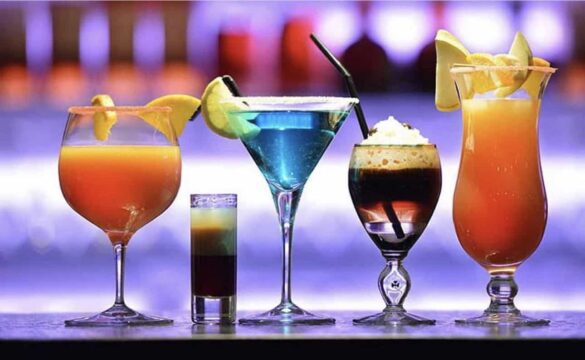
Cocktails it is a drink obtained through a proportionate and balanced mixture of different alcoholic and non-alcoholic ingredients and flavourings. A well-executed cocktail must have balanced structure, aroma and color; if performed without the use of alcoholic components it is called a non-alcoholic cocktail.
There are several types of tumblers available, each serving different purposes:
- Glass Tumbler: A standard drinking glass usually used for water, juice, or other beverages.
- Stainless Steel Tumbler: Known for their durability and ability to keep drinks hot or cold for extended periods, these tumblers are popular for outdoor activities and commuting.
- Travel Tumbler: Designed with a secure lid and insulation to prevent spills and maintain the temperature of the drink. They are convenient for on-the-go use.
- Shaker Tumbler: Mainly used to mix ingredients for shakes, smoothies, or cocktails. They usually come with a secure lid and a mixing mechanism.
- Decanter Tumbler: Primarily used for serving and aerating wine. They have a wide base and allow for easy swirling of the wine to release aromas.
These are just a few examples of tumblers commonly used for various purposes.
The name of the glassware for various drinks includes:
1. Cognac Glass or Snifter
2. Rocks Glass or Old Fashioned Glass for spirits
3. Cocktail Glass or Martini Glass for cocktails
4. Water Glass or Tumbler
5. Wine Glass for wine
These are some common types of glassware used for different types of drinks
Mixing Techniques Every Bartender Should Know
Introduction
The 7 mixing techniques every bartender should have in their repertoire.
The Techniques
Knowing them will allow you to:
– reinforce your skills if you’re already an experienced bartender;
– speed up your learning process if you’re studying the art of bartending.
That said, the time has come. Keep a cocktail within reach and let’s get started!
Mixing Technique: Neat
Let’s start with the simplest one.
It’s called Neat and involves pouring a single product directly into the glass.
The product must be just one, and the glass must be without ice. Once the liquid is poured, it’s ready to serve.
It’s a simple yet widely used technique. Amari and grappas are examples of products served this way.
Mixing Technique: Build
What is the Build method?
The drink is built directly in the glass.
The liquid is poured into a glass, which may or may not contain ice, depending on the recipe.
Build refers to drinks with multiple ingredients poured one after the other.
Mixing Technique: Build Layer
This preparation method involves creating a layered drink—layers that are visible to the naked eye.
Layering occurs because the ingredients have different specific weights.
To make the most of the Build Layer technique, it’s important to know the specific gravity of each component.
The heaviest ingredient is poured first, followed by the lighter ones in sequence.
This way, the heaviest ingredient settles at the bottom, acting as a cushion for the rest.
Tip: to reduce the pouring force, a bar spoon is often used to break the flow gently.
Mixing Technique: Dry Shake
The Dry Shake is a shaking technique used to emulsify the drink.
It’s done without ice and is often used in cocktails that include egg whites or foaming agents.
Mixing Technique: Stir & Strain
For this method, you’ll need a mixing glass and a bar spoon.
Step one: fill the mixing glass with ice.
Step two: chill it using the bar spoon.
Once the glass is chilled, discard the excess water that has formed, but keep the ice in the mixing glass.
Now you’re ready to add the ingredients, which will be stirred and blended with the bar spoon.
Mixing Technique: Shake & Strain
Shake & Strain involves shaking the ingredients inside a shaker (not the mixing glass).
To summarize:
– Stir & Strain → ingredients are stirred in the mixing glass using a bar spoon.
– Shake & Strain → ingredients are shaken, usually in a shaker.
There's also Shake & Double Strain, which includes a second filtration to remove finer particles or ice shards.
Mixing Technique: Throwing
Throwing consists of “throwing” the drink from one mixing tin to another.
We say “throwing” because the two tins are held at a distance, so the liquid falls in a kind of cascade.
The process:
– All ingredients are poured into a mixing tin.
– Ice is added.
– A strainer is placed to keep the ice in while throwing.
– The liquid is poured from one tin to the other in an aerial stream.
This step is usually repeated 4 or 5 times to achieve proper aeration and texture.
These are some common types of glassware used for different types of drinks