
How to Present a Wine Professionally
Wine presentation is an essential skill in fine dinning, luxury hospitality and private aviation.
Proper wine presentation enhances the guest experience and showcases the professionalism of the presenter. Here is a step-by-step guide on how to present wine in a professional manner.
1.Preparation Before Presentation
- Ensure that the wine is stored at the correct serving temperature.
- Use wine glasses that are transparent, clean and polished, with no residue or odour.
- Choose the appropriate glass shape according to the type of wine to be served.
- Prepare a white cloth or napkin to clean the bottle, if necessary.
- Read the label of the chosen wine: (name of wine, grape variety, producer, appellation, vintage if applicable, , region).
Small and medium sized wine glasses are for wines that are not very rich in aroma and structure, while larger sized glasses are for wines rich in aroma and structure).
For certain types of red wines with great structure and great value, the goblets have dedicated shapes.
2.Approaching the Guest
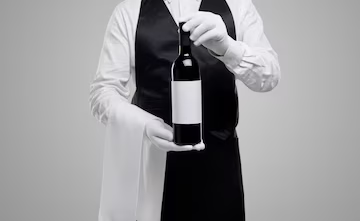
- Always carry the bottle to the base accompanied by a serving napkin.
- Always show the label
- Position yourself to the left of the guest (if possible)
- Introduce yourself (e.g.: Good morning Mr., I am Antonio your sommelier, today I propose to you or the wine you have chosen is ...)
- Remaining at the guest's side if possible, present the bottle from the left, extending the arm in front of the guest, helped by the right hand, place the bottle with the neck towards the centre of the table and with the label still facing the guest. What to say to the guest who has chosen the wine:
- Name of wine: (this is the wine you have chosen or that I have recommended)
- vine variety:
- Producer
- Appellation (DOCG or DOC for Italy, AOC for France....)
- Vintage if applicable
- You can give some information about the aging or maturation time.
- Please wait for the host's approval before proceeding.
3.Opening the Bottle
For still wines:
- Prepare the necessary mise-en-place for wine service on the service table.
Place the bottle with the label facing the guest.
To the right of the bottle, place the service napkin, the tasting glass, and the small plate. - Use the professional sommelier corkscrew to make two clean cuts below the lip of the bottle. Then score the capsule from bottom to top and remove it. Place the capsule on the small plate.
- Using the service napkin, properly clean the neck of the bottle, both on the top where the cork is, and along the side.
- Insert the corkscrew into the center of the cork and, without moving the bottle, begin to penetrate the cork.
The corkscrew spiral should make five turns to reach the bottom of the cork. - Extract the cork with elegant movements, never bending it during extraction.
Before fully removing it, assist the motion using the service napkin. - Rotate your hand counterclockwise to remove the cork smoothly and without breaking it.
- Bring the cork close to your nose using the corkscrew, and smell it both frontally and laterally to check for any faults.
- Using the service napkin, unscrew the cork from the corkscrew without touching it with your hands.
Place the cork on the small plate together with the capsule. - If necessary, clean the inside of the bottle neck from any sediment brought up by the cork, using the tip of the napkin from the inside out.
- Ask the guest if they wish to taste the wine. If they agree, pour a small amount into the tasting glass and proceed with the evaluation—without expressing any judgment.
- Serve a small quantity of wine to the guest who ordered it.
- After serving the wine from the right, keep the bottle upright, positioned to the right of the guest, with the label facing them.
Wait for a positive gesture from the guest, then proceed with the service.
Sparkling wines:
- Prepare the necessary mise-en-place for wine service on the service table.
Place the bottle with the label facing the guest.
To the right of the bottle, position the service napkin, the tasting glass, the small plate, and, if necessary, the sparkling wine tongs. - Use the professional sommelier corkscrew to make two clean cuts below the lip of the bottle. Then score the capsule from bottom to top and remove it. Place the capsule on the small plate.
- Identify the wire loop of the cage securing the sparkling wine cork. Place your right thumb over the capsule, and with your left hand, loosen the wire cage.
- For service safety, remove your right thumb from the capsule, use your left hand to free the cage from the cork, and then place your right thumb back onto the cork. Set the wire cage on the small plate.
- Hold the bottle facing forward, tilting it about 40° to the right or left—what matters is that no guests are in line with the cork.
- You can now hold the cork with one hand and rotate the bottle with the other, or vice versa.
The cork should be extracted with minimal noise; it is said the wine should "breathe" quietly. - Bring the cork to your nose, and smell it both frontally and from the side to check for any faults.
Place the cork on the small plate along with the capsule and wire cage. - Ask the guest if they would like to taste the wine. If they agree, pour a small amount into the tasting glass and perform the evaluation—without expressing any judgment.
- Then, serve a small amount of wine from the right to the guest who ordered it.
- After serving, keep the bottle upright, positioned to the right of the guest, always with the label facing them. Wait for a positive signal from the guest before continuing with the service.
4.Pouring the Wine
As soon as the guest who tasted the wine gives a positive response, we can begin serving the other diners.
The service rules are as follows:
- Ladies are served first, from the oldest to the youngest
- Then the gentlemen
- Lastly, don’t forget to top up the glass of the guest who tasted the wine
There are also stricter and more specific rules in cases involving heads of state, clergy, or celebrities.
The quantity to be served:
Usually, 6 to 7 cl of wine are poured into the glass, in order to maintain the correct serving temperature of the wine.
If there are more than seven guests at the table, it’s good practice to pour slightly smaller amounts to ensure at least 1–2 extra servings remain in the bottle.
You never know—one of the guests might ask for a little more, and you wouldn’t want the bottle to be empty.
In cases where the service includes a single glass of wine, the standard serving is 10 cl, unless otherwise specified by management.
5.Describing the Wine (Optional but Recommended)
- During service, if a guest asks for information about the wine being served, we may offer a brief technical description.
It is good practice for the entire service team to be able to communicate consistent and accurate information. - A brief mention of the wine region, the producer’s style, and the key characteristics of the terroir is appropriate.
- As for the technical evaluation, we can describe the wine in terms of its color, intensity, and any nuances. On the nose, we may comment on the intensity and the aromas that best represent the wine’s character.
On the palate, we can give information regarding the presence or absence of residual sugars, alcohol content, smoothness, freshness, tannins (if present), and any noticeable sapidity. - It is good etiquette never to show off one's knowledge, and to reserve more detailed explanations for guests who specifically request them.
• Example:
“This Chardonnay from Burgundy offers aromas of citrus and white flowers, with a balanced acidity and a creamy finish.”
6. Serving Temperature:
Talking about serving temperatures is not always a topic the guest is familiar with.
Informing the guest in advance that "the wine they have chosen, or that has been recommended, will be served at a temperature of... °C" can be a good way to understand whether the guest agrees or not.
Taking into account the characters of the different wines, temperatures may vary by a few degrees. Serve white wines chilled but not too cold, and red wines slightly below room temperature.
Champagne and sparkling wines should be served well-chilled.
- 8° - 14° C. Sparkling wines
- 10° - 14° C. White wines
- 10° - 16° C. Rosé wines
- 16° - 20°C. Red wines
- Starting from the proposed basic serving temperature, the more intense the aromas and the more structure is present in the wines, increase the serving temperature by 2-4°C.
- Example: Vintage Chardonnay 10°C, wood-aged Chardonnay 14°C, aromatic white wine 12°C
- Low temperatures mask defects and inhibit the perception of aromas
7. Decantation or Aeration of wine?
Wine is technically decanted for three main reasons:
To aerate the wine and help it open up
Young or structured wines may benefit from oxygen exposure to better express their aromas and flavors. Pouring into a decanter accelerates this process.
For temperature adjustment or service presentation
Sometimes wine is decanted to slightly adjust the serving temperature, or simply to enhance the elegance and ritual of the service—especially in fine dining contexts.
To eliminate any harmless off-odors
Occasionally, a wine may have reductive or closed aromas that don’t compromise its quality but can affect the first impression. Decanting can help these dissipate, improving the tasting experience.
Wine is decanted for:
- Besides the three previous reasons.
- To separate the wine from any sediment
This is especially common with older red wines, where natural sediment forms over time. Decanting ensures the wine is clear when served.
Any other motivation doesn't make much sense.
PS: In cases where the serving temperature of a wine (for example, a red wine) is too low due to storage in an overly cold environment, you can gently warm the decanter externally under lukewarm water. This helps slightly raise the temperature of the glass, making it easier to bring the wine closer to its ideal serving temperature.
Placing the bottle near heat sources—such as an oven, coffee machine, or similar—is definitely a serious mistake and should be avoided.
8.Monitoring and Offering Assistance
"With great courtesy, we approach the table to ask the guest whether they appreciated our suggestions."
Or
"With polite discretion, we approach the table to check whether the guest enjoyed our recommendations.
- ✔ Speak clearly and confidently.
- ✔ Maintain elegant posture and movements.
- ✔ Adapt your style to the guest’s level of knowledge—keep it simple for beginners, detailed for wine enthusiasts.
- ✔ Always smile and be courteous—wine is about enjoyment!
The correct side for presenting wine depends on the setting and service standards, but in general:
• Fine dining & luxury service (including private aviation and yachting): Present the bottle from the guest’s left side, as this is the standard for beverage service. You pour from the right.
In private aviation, where space is limited, flexibility is key. The most important thing is to maintain elegance, ensure visibility of the label, and pour smoothly.
9. Mise en place
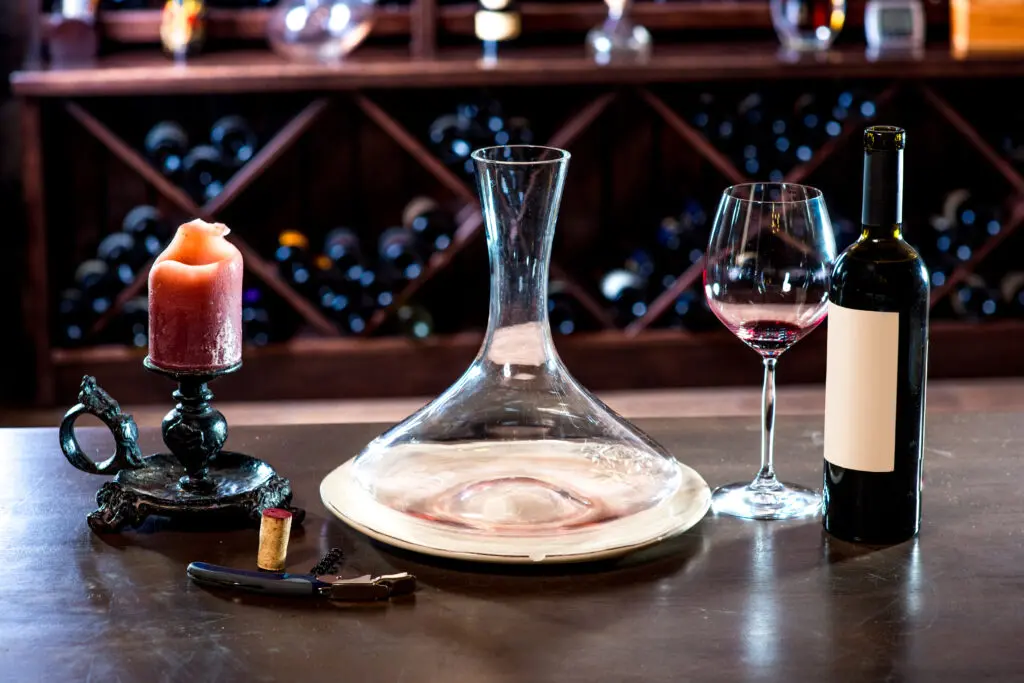
Sparkling wine: napkin, glass, corkscrew, saucer, tongs
Classic: napkin, glass, corkscrew, saucer
Decanting: napkin, glass, corkscrew, 2 saucers, matches, candle, basket, decanter
An important rule in wine service is to open the bottle at the moment the customer orders it at the table.
If the customer requests the bottle to be opened in advance—even by a few hours earlier —we can certainly accommodate the request, or alternatively suggest that they discover during their lunch or dinner how the wine itself evolves and expresses its character.
In some cases, especially with wines that have aged for many years, it is not advisable to decant them, as contact with oxygen could compromise the wine’s delicacy and fragility.