
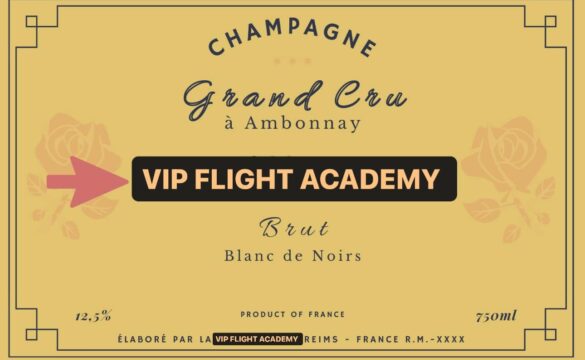
The packaging of Champagne is called habillage, and is composed of a capsule that covers the cork, a metal cage and a collar. A label is affixed to the body of the bottle, sometimes accompanied by a back label, containing the legal wordings and information for consumers.
The mandatory information is the controlled designation of origin "Champagne", the sugar content, the alcoholic strength (% vol), the nominal volume (in l, cl or ml), the brand, the name of the producer, the municipality in which its registered office is located and France, the professional registration, the identification of the lot, the mention "produit de France".
The wording Champagne
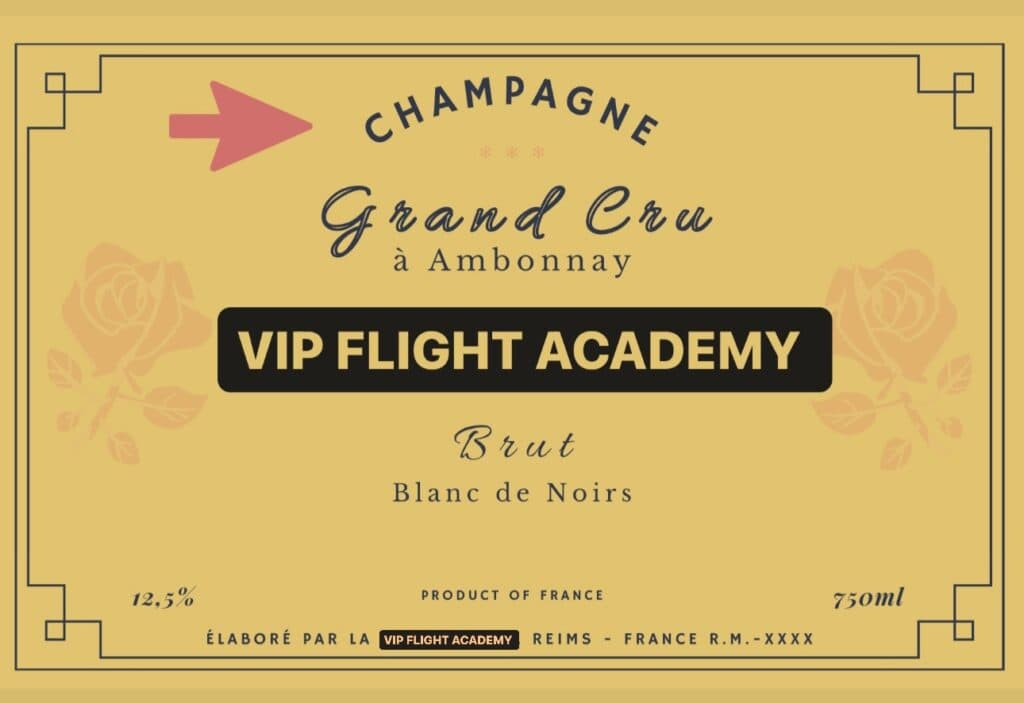
Champagne is an AOC – Appellation d'Origine Contrôlée, which exclusively designates a sparkling wine produced in France, in the Champagne wine region, according to a method strictly defined by law. The term AOC (acronym as such or in full) can also be omitted on the label but not the word Champagne. If it is not present it means that we are faced with another sparkling wine.
Quality features
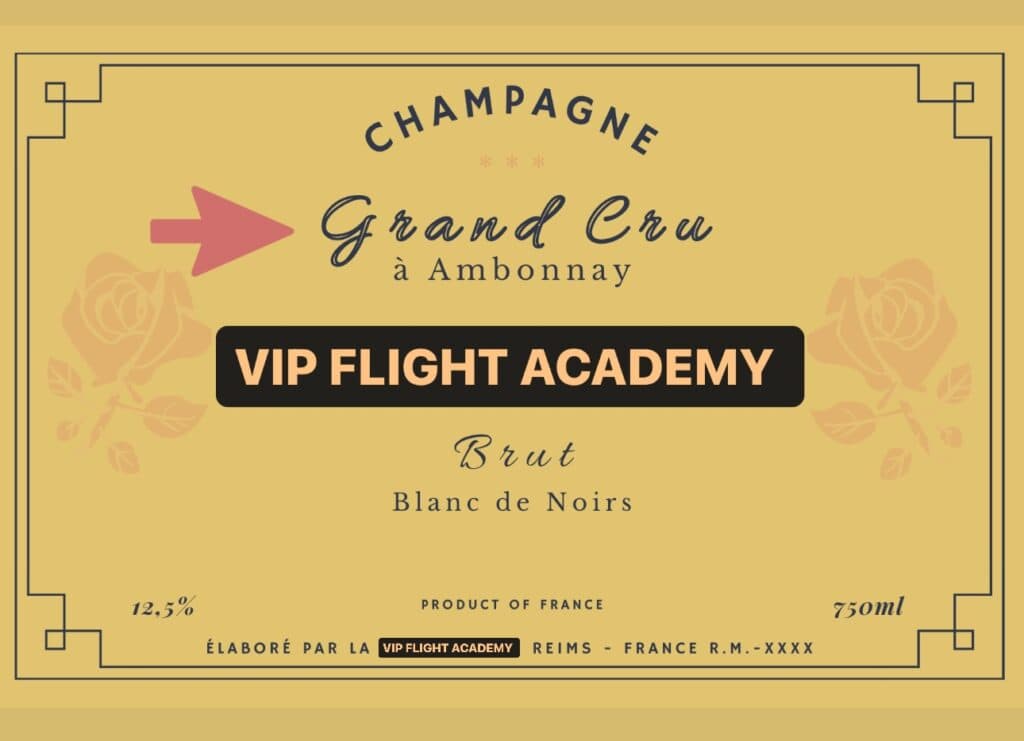
There are three quality characteristics of a Champagne: Grand Cru, Premier Cru and Cru.
- 17 municipalities are classified as Grand Cru,
- - In the Montagne de Reims: Ambonnay, Bouzy, Louvois, Verzy, Verzenay, Maill, Beaumont-sur-Vesle, Sillery and Puisieulx.
- - In the Vallée de la Marne: Aÿ and Tours-sur-Marne.
- - In the Côte de Blancs: Oiry, Chouilly, Cramant, Avize, Oger and Mesnil-sur-Oger.
- 41 Premier Cru and 255 Cru.
The name of the manufacturer
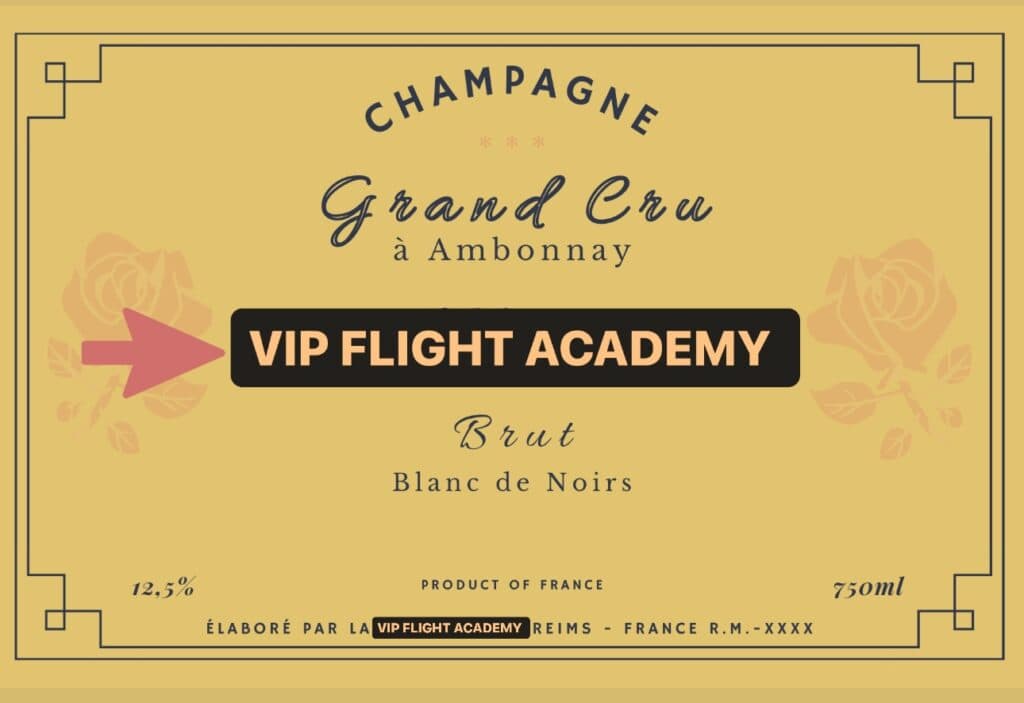
Usually highlighted in a larger font we find the name of the producer, the commercial brand or Vigneron. In some cases the fictional name of Champagne is present.
The dosage
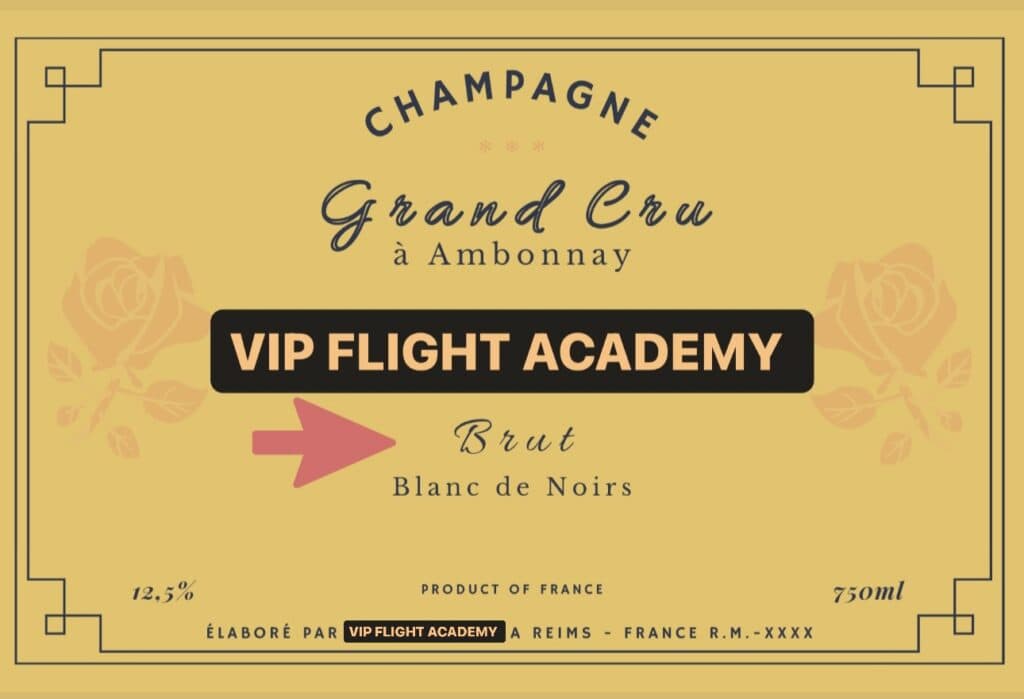
The sugar content, or dosage, is one of the mandatory mentions on the label of a bottle of Champagne which allows the consumer to identify the wine he has chosen. The quantity of sugar is inserted with the liqueur d'expédition (or liqueur de dosage).
The typology
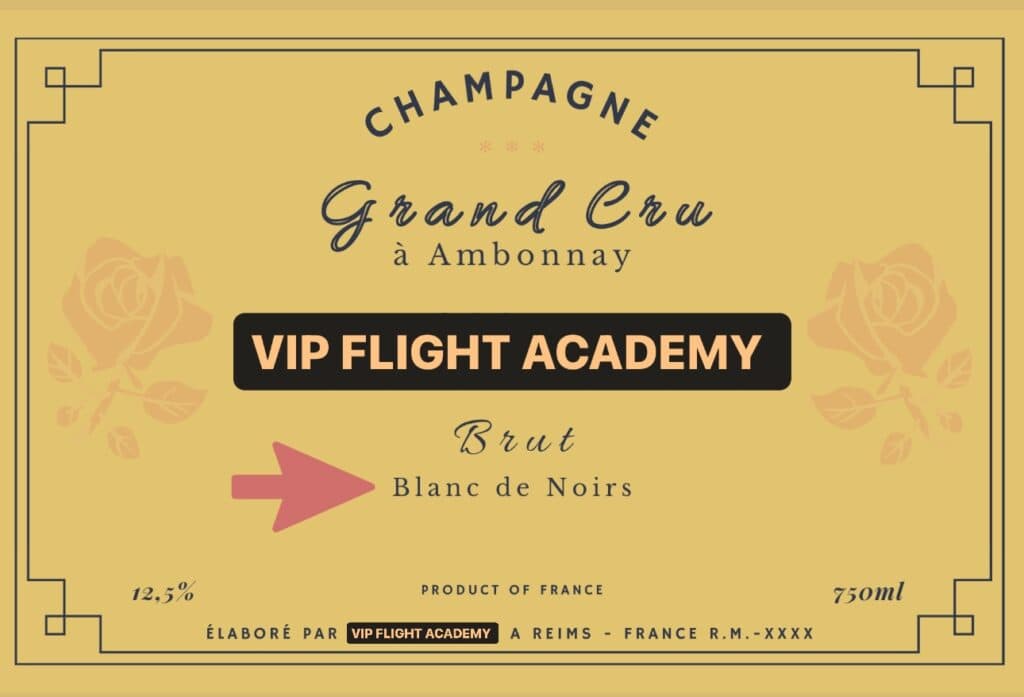
The production technique and the vintage of the grapes present in the cuvée identify Champagne as:
Blanc de Blancs, obtained from the assembly of only white grapes, even if from different vintages.
Blanc de Noirs, obtained from the assembly of only black grapes.
Pinot Noir or Pinot Meunier, together or individually, not necessarily from the same vintage.
Rosé, obtained by blending white wine and red wine (in percentages from 5 to 20%) or by maceration (saignée) Millesimé, Champagne with grapes from a single harvest (made for excellent vintages). The indication of the vintage must also appear on the cap.
BSA or brut sans année, obtained with wines of different vintages.
Monocru, with grapes coming from a single village of origin.
Cuvée de prestige, is the flagship of a producer, the assembly of exceptional wines, usually preserved in a special format. It can also be Millesimated.
Professional category
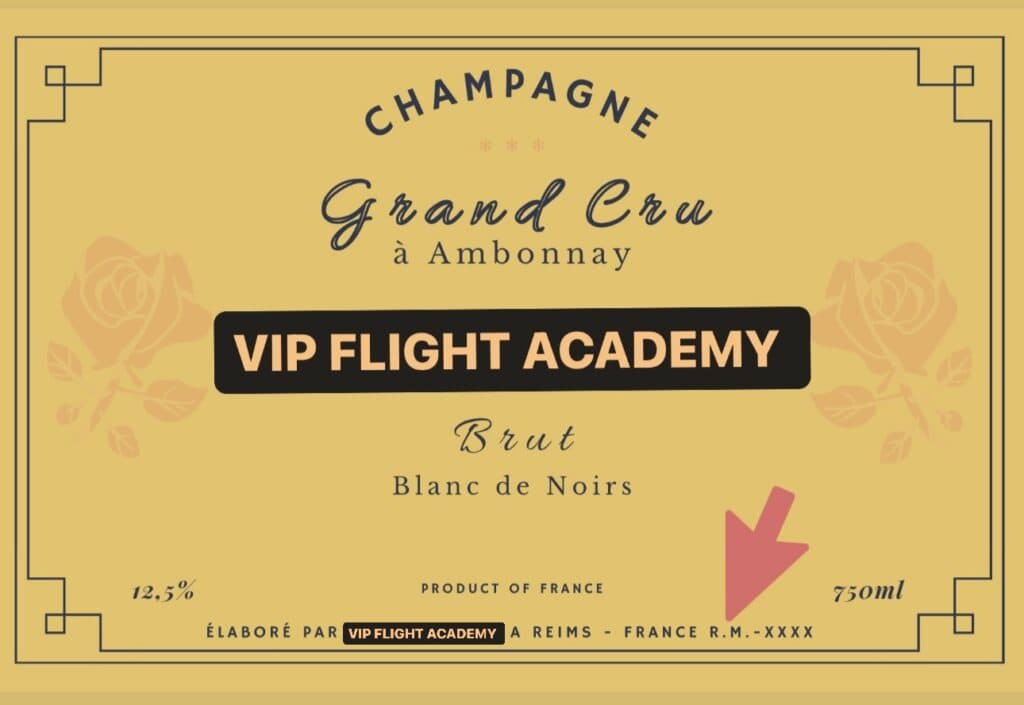
Each label must indicate some letters and an identification and control number, issued by the Comité Interprofessionnel du Vin de Champagne, which correspond to the professional category of the producer:
MA Marque d'Acheteur, products created for large-scale distribution
NM Négociant Manipulant, natural or legal person who, in addition to the grapes produced in his own vineyards - if he owns them - purchases grapes, must or wine and processes them in his own cellar
RM Récoltant Manipulant processes the wines in its own cellar using exclusively proprietary grapes. These are generally high quality and limited production products
RC Récoltant Coopérateur, winemakers who give their grapes to a cooperative that is responsible for carrying out the winemaking; the bottles are returned to the individual winemakers for marketing
CM Coopérative de Manipulation produces wines produced with its members' grapes in its own cellar
SR Société de Récoltants, produces wines from grapes belonging to members of the same family
ND Négociant Distributeur, a trader who buys ready-to-drink bottles and markets them under his own brand.
Understanding the Classification Labels for proper presentation
Always introduce the champagne by holding the bottle with the label facing the guest and give a detail description
There’s a wide variety of Champagne wines. It isn’t always easy to find your way around! A quick overview of a few notions that will help you better understand the wine that’s in the bottle.
Dosage: - it all depends on how much dosage liqueur (a mixture of sugar and wine) is added to the Champagne at the final stage of its elaboration. The quantity of liqueur used for the dosage is set according to the type of wine you want to obtain.
Although 90% of Champagne wines are "Brut", there are a number of sweeter ones.
Here's how Champagne wines are classified depending on sugar levels:
a) ZERO DOSAGE, BRUTE NATURE or PAS DOSE NATURE- It is possible to add the liqueur d’expédition or the same wine to top up the bottle, but adding sugar is prohibited. The sparkling wine must not have a residual sugar content exceeding 3 g/litre.
c) EXTRA BRUT - From 0 to 6 grams per litre.
d) BRUT - From 0 to 12 grams per litre.
e) EXTRA DRY - between 12 and 17 g/liter
f) SEC/DRY - between 17 and 32 g/litre
g) DEMI SEC/ SEMI DRY - between 32 and 50 g/litre
h) DOUX / SWEET - exceeding 50 g/ litre
Grape variety- when they are mentioned, the grape varieties in the blend provide indications of the Champagne’s profile. As regards chardonnay, we’d be looking for liveliness, minerality and notes of citrus fruits and white flowers. With pinot noir, it would be body, structure, red fruits and such flowers as violets and roses. As for meunier, it provides fruity notes, roundness, and notes of apples, pears and yellow fruits.
The designation Blanc de Blancs indicates that the Champagne is only made from white grape varieties, mainly Chardonnay, while a Blanc de Noirs is made from red grape varieties alone, Pinot Noir and/or Meunier.
Vintage - a Champagne can be vintage or otherwise. When a harvest is truly outstanding, the winemaker can decide to create a cuvée from that year’s grapes alone.
Brand- Some iconic names are references in themselves. Through the choices they make in their vineyard and wine cellar, each producer develops their own recognisable style, their signature, to be found in each bottle.
Labels - Some labels and notices may indicate how the Champagne was made: High Environmental Value, Organic, etc.